🔬 The Amazing World of Electronic Components: A Complete Guide for the Curious Mind
From glowing glass bottles to microscopic chips — everything you need to know about the building blocks of modern electronics, explained in common man language.

Image: Various electronic components — Kae, Public domain, via Wikimedia Commons
⚡ A Quick Trip Through Electronics History
Imagine trying to build a smartphone back in 1900. Impossible, right? But that's exactly where our story begins — with something called a vacuum tube.
🕰️ The Vacuum Tube Era (1904–1947)
In 1904, a man named John Ambrose Fleming invented the Fleming valve — a glass bulb with the air sucked out of it that could control the flow of electricity. By 1906, Lee De Forest added a third piece inside (called a "grid") and created the triode — the first device that could amplify signals.
These glass bottles — called vacuum tubes or valves — became the heart of all electronics. They powered radios, early TV sets, and even the ENIAC computer (1945), which used 17,468 of them, weighed 30 tons, needed 150 kilowatts of power, and filled an entire room. And it could do less math than your pocket calculator.

Image: Two operators preparing the ENIAC computer in 1946. U.S. Army Photo, Public domain, via Wikimedia Commons
Think of it this way: Vacuum tubes were like old steam engines — powerful but huge, hot, and constantly breaking down. Each tube lasted only about 3,000 hours, and when one failed, technicians had to hunt through thousands to find the bad one.
🔌 The Transistor Revolution (1947–1970s)
In 1947, three scientists at Bell Labs — John Bardeen, Walter Brattain, and William Shockley — invented the transistor. It did everything a vacuum tube could do, but it was tiny, ran cool, used almost no power, and lasted forever.
This was the single most important invention of the 20th century. Within a decade, transistors replaced tubes in radios (the iconic 1954 Regency TR-1 was the first transistor radio), hearing aids, and early computers. Suddenly, electronics could be portable.
Think of it this way: If vacuum tubes were steam engines, transistors were the internal combustion engine — smaller, more efficient, and able to go anywhere.
🧠 The Integrated Circuit (1958–Today)
In 1958, Jack Kilby at Texas Instruments took the next leap — he built an entire circuit (transistors, resistors, capacitors) on a single piece of semiconductor material. The integrated circuit (IC) was born.
By 1971, Intel released the 4004 microprocessor — a chip with 2,300 transistors that could do general-purpose computing. Today's Apple M3 Ultra has over 100 billion transistors on a chip smaller than a postage stamp.
This is Moore's Law in action: Gordon Moore predicted in 1965 that transistor counts would double roughly every two years. It held true for over 50 years — though we're now reaching physical limits.
📍 1. Vacuum Tubes / Valves
What it is: A sealed glass (or metal) tube with the air removed. Inside, a heated cathode releases electrons that travel to an anode, controlled by metal grids in between.
Think of it this way: A water faucet — the grid is the handle. A tiny movement of the handle controls a massive flow of water.
Where it's used: Guitar amplifiers (guitarists swear by the warm "tube sound"), high-end audio equipment, vintage radio restoration, and high-power radio transmitters.
Alternatives: Transistors, MOSFETs, and integrated circuits — they do the same job in a fraction of the size.
Pros: Warm pleasing sound for music; can handle huge voltage spikes; simple to repair; naturally handles overloads gracefully.
Cons: Large, heavy, and fragile (glass); generates intense heat; uses lots of power; tubes burn out and need replacement.
📍 2. Resistors
What it is: A simple component that resists the flow of electricity. Measured in ohms (Ω). Made from carbon, metal film, or wire.
Think of it this way: A narrow pipe in a water system — it restricts the flow of water. The longer and thinner the pipe, the more restriction.
Where it's used: Everywhere — limiting current to LEDs, dividing voltages, setting timing circuits (with capacitors), pulling up/down logic pins on microcontrollers.
Alternatives: A potentiometer (adjustable resistor), a thermistor (heat-sensitive), or a photoresistor (light-sensitive).
Pros: Cheap as dirt (pennies each); extremely reliable (no moving parts); available in infinite range of values.
Cons: Wastes energy as heat; fixed value (can't change without swapping); drifts slightly with temperature.
📍 3. Capacitors
What it is: Two metal plates separated by an insulator (called a dielectric). It stores electrical energy in an electric field. Measured in farads (F).
Think of it this way: A water tank — it fills up slowly with charge, stores it, and dumps it instantly when needed. It also smooths out pressure (voltage) surges in a pipe.
Where it's used: Smoothing power supply ripple (turning bumpy DC into smooth DC), blocking DC while passing AC signals (audio coupling), timing circuits (camera flash), noise filtering on circuit boards.
Types: Ceramic (tiny, general purpose), electrolytic (big, high capacity), tantalum (stable but expensive), supercapacitors (huge capacity, slow discharge).
Pros: Charges and discharges extremely fast; no moving parts; filters high frequencies beautifully; available from tiny to huge values.
Cons: Electrolytic types dry out and degrade over years; have a maximum voltage (exceed it = pop!); some types are polarity-sensitive (install backwards and they can explode).
📍 4. Inductors
What it is: A coil of wire that stores energy in a magnetic field when current flows through it. Measured in henries (H). May have an air, iron, or ferrite core.
Think of it this way: A heavy flywheel on an engine — it resists changes in speed (current). It smooths out surges and keeps things steady.
Where it's used: Power supply filters (alongside capacitors), transformers, blocking AC while passing DC (chokes), radio tuning circuits, wireless charging.
Pros: Excellent at filtering power; can handle high currents; essential for radio and wireless circuits; enables transformers.
Cons: Large and heavy (especially with iron cores); can be expensive; generates magnetic interference; can saturate (reach magnetic limit and stop working).
📍 5. Diodes
What it is: A semiconductor that lets current flow in only one direction. Like a one-way gate for electricity.
Think of it this way: A one-way valve in a plumbing system — water flows freely in one direction but is completely blocked in reverse.
Where it's used: Converting AC to DC (rectifiers in phone chargers), protecting circuits from reverse polarity, LEDs (they're diodes that emit light!), voltage regulation (Zener diodes), radio signal detection.
Types: Standard silicon (0.6-1.0V drop), Schottky (faster, 0.3V drop), Zener (regulates voltage), LED (emits light), photodiode (detects light).
Pros: Simple, cheap, and reliable; very fast switching; many specialized types for different jobs.
Cons: The voltage drop wastes a bit of power as heat; can overheat if too much current passes; reverse voltage limit can be exceeded.
📍 6. Transistors (BJT — Bipolar Junction Transistor)
What it is: A three-legged semiconductor (Emitter, Base, Collector) where a small current at the base controls a much larger current between the other two legs. An amplifier and a switch rolled into one.
Think of it this way: A lever — a tiny push on one end moves something huge on the other. Or imagine a door that opens with a gentle finger-push but moves a massive metal slab.
Where it's used: Audio amplifiers, signal processing, switching small loads, sensor circuits, classic electronics projects.
Alternatives: MOSFETs (more common in modern designs), relays (for switching only).
Pros: Very good at amplification; nice linear response for audio; simple to set up; can switch very fast.
Cons: Needs steady current just to stay on (less efficient); can overheat; limited to lower voltages; MOSFETs are generally better for modern power circuits.
📍 7. Integrated Circuits (ICs)
What it is: An entire circuit — thousands to billions of transistors, resistors, and capacitors — fabricated on a single sliver of silicon. Packaged in a black plastic or ceramic case with metal pins.
Think of it this way: A complete factory inside a box — raw electrical signals go in, processed signals come out. You don't need to know what happens inside; the IC just does its job.
Where it's used: Literally everywhere — your microwave's control panel, your phone's processor, the chip in your car key, the amplifier in your hearing aid. Modern civilization runs on ICs.
Types: Logic gates (7400 series), operational amplifiers, timers (the famous 555), microcontrollers (tiny computers), memory chips, custom ASICs.
Pros: Incredibly compact; cheap per function (mass production); highly reliable (no loose wires); can achieve impossible complexity.
Cons: Can't be repaired (replace only); huge initial design cost; sensitive to static electricity; can become obsolete.
📍 8. MOSFETs
What it is: Metal-Oxide-Semiconductor Field-Effect Transistor — a voltage-controlled switch. Voltage on the "gate" leg creates an electric field that opens or closes the path between "source" and "drain."
Think of it this way: A light switch that requires almost zero force to flip — the voltage on the gate is like a gentle finger-touch that opens a massive power channel.
Where it's used: Power supplies (phone chargers, laptop bricks), motor drivers (drones, EVs), every single CMOS chip (99% of all digital chips use MOSFETs), battery protection circuits.
Pros: Extremely efficient (very low resistance when on); can switch huge currents; almost no input current needed; incredibly fast switching speed; the foundation of all modern digital electronics.
Cons: The gate oxide layer is extremely delicate — one touch of static electricity can destroy it; gate capacitance needs drive current for fast switching; can oscillate if poorly designed.
📍 9. Microprocessors (CPUs)
What it is: The brain of a computer. A single chip (or a few) containing an Arithmetic Logic Unit (ALU), control unit, registers, and cache memory. It executes instructions — any instructions you give it.
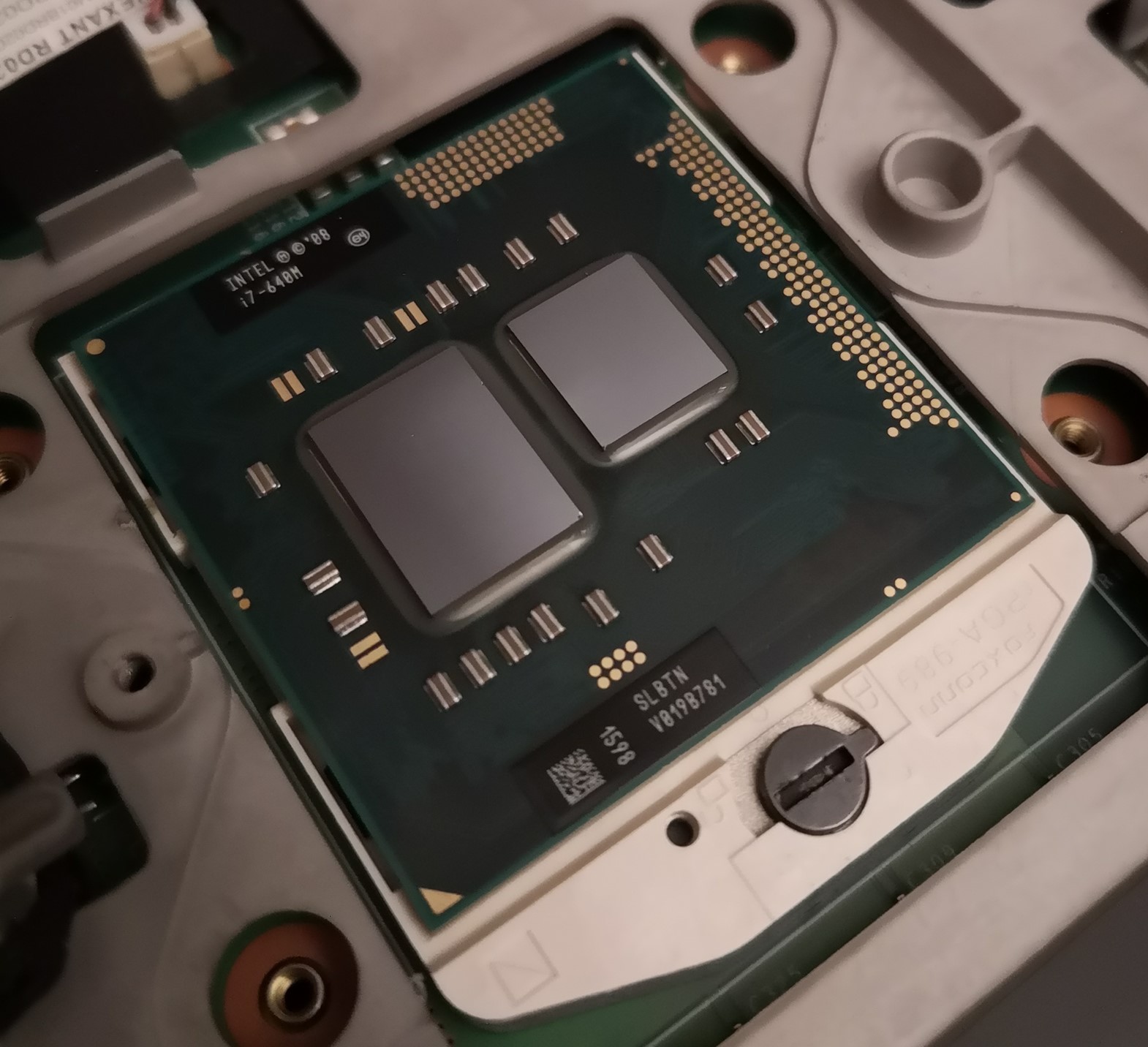
Image: Intel i7-640M processor — Ptrump16, CC BY 4.0, via Wikimedia Commons
Think of it this way: The CEO of a company — it takes orders (software instructions), delegates tasks (to memory, storage, peripherals), does the math, and makes decisions.
Examples: Intel Core i9, AMD Ryzen, Apple M-series, ARM Cortex in your phone.
Where it's used: PCs, laptops, servers, smartphones, game consoles, embedded systems, car ECUs — anything that needs to run software.
Alternatives: Microcontrollers (CPU + memory on one chip), DSPs (specialized for signals), FPGAs (reprogrammable hardware).
Pros: Incredibly versatile (can do anything software can describe); billions of operations per second; massive software ecosystem.
Cons: Complex to design around; high power consumption; generates significant heat; overkill for simple tasks.
📍 10. GPUs (Graphics Processing Units)
What it is: A specialized processor with thousands of simpler cores designed to do many calculations simultaneously. Originally built for graphics, now used for general parallel computing.
Think of it this way: A thousand accountants working on different parts of the same problem at the same time, versus a single genius (CPU) working through one step at a time.
Examples: NVIDIA RTX 4090, AMD Radeon, Apple M-series GPU.
Where it's used: Gaming, 3D rendering, video editing, AI training (NVIDIA CUDA), scientific simulations, cryptocurrency mining (less now).
Alternatives: TPUs (Google, AI-specific), FPGAs, CPUs (much slower for parallel work).
Pros: Massively parallel (thousands of cores); excellent at matrix math (crucial for AI); can render photorealistic graphics in real-time; huge memory bandwidth.
Cons: Very high power consumption (300-450+ watts); generates extreme heat; overkill for simple tasks; expensive; physically large (takes 2-3 slots).
📍 11. TPUs (Tensor Processing Units)
What it is: Google's custom chip designed specifically for one job — running neural networks. At its core is a Matrix Multiply Unit (MXU) that crunches AI math at blazing speed.
Think of it this way: A custom factory built to make one specific product as efficiently as possible — more energy-efficient than re-tooling a general factory for the same job.
Where it's used: AI inference and training (Google Cloud), powering Google Search, Translate, and Photos; data center AI workloads.
Alternatives: NVIDIA GPUs (more flexible, less efficient for pure ML), AMD GPUs, Intel Habana Gaudi, Groq LPUs.
Pros: Extremely efficient for ML (best operations-per-watt); very fast for neural network inference; lower latency than GPUs for AI tasks.
Cons: Only works for ML workloads (can't play games on it); not available for purchase (cloud-only); less flexible than GPUs; rapidly evolving market.
📍 12. Chiplets
What it is: Instead of building one giant chip, you build several smaller "chiplets" and connect them inside one package using high-speed interconnects like AMD's Infinity Fabric or the Universal Chiplet Interconnect (UCIe).
Think of it this way: Building a house from pre-fabricated rooms instead of constructing the entire house as one piece. If one room has a problem, you just swap that room — you don't tear down the whole house.
Where it's used: AMD Ryzen and EPYC processors (multiple CPU chiplets + one I/O chiplet), Intel Meteor Lake (GPU + CPU + SoC tiles), Apple M-series Ultra (two Max dies fused).
Alternatives: Monolithic die (one big chip — harder to manufacture), multi-chip module (older, slower interconnect).
Pros: Much better manufacturing yields (smaller dies = fewer defects); cost-effective; allows mixing different manufacturing processes (compute on cutting-edge 3nm, I/O on cheaper 12nm); enables CPU + GPU + memory in one package.
Cons: Complex packaging technology; slight latency penalty between chiplets; thermal management challenges; requires advanced packaging (TSMC CoWoS, Intel EMIB).
📍 13. LEDs (Light Emitting Diodes)
What it is: A special diode that emits light when current flows through it. Electrons "fall" into holes in the semiconductor material and release their energy as photons (light).
Think of it this way: A one-way street for electricity where cars (electrons) fall into potholes (holes) and release their energy as tiny flashes of light.
Where it's used: Lighting (homes, cars, streetlights), screens (TVs, phones, monitors), indicators on electronics, remote controls (infrared), decorative lighting, traffic signals.
Alternatives: Incandescent bulbs (warm but inefficient), CFLs (fluorescent, contain mercury), OLEDs (flexible displays).
Pros: Extremely efficient (100+ lumens per watt — 10x better than incandescent); very long life (50,000+ hours); instant on (no warm-up); durable (solid state); wide color range.
Cons: Needs precise current control (a driver circuit); heat-sensitive (bright LEDs need heatsinks); color can shift over years; quality varies hugely between cheap and premium.
📍 14. Transformers
What it is: Two or more coils of wire wound on a magnetic core. Changes AC voltage levels using electromagnetic induction — no moving parts.
Think of it this way: A gearbox for voltage — you can trade high voltage for more current (like trading speed for torque in a car) or vice versa.
Where it's used: Power adapters (converting 230V wall power to safe low voltage), audio equipment (impedance matching), medical equipment (galvanic isolation for safety), doorbells.
Alternatives: Switching power supplies (buck/boost converters — much smaller and lighter for the same job).
Pros: True electrical isolation between input and output (safety!); very robust and reliable (decades of life); can handle massive power (megawatts in grid transformers).
Cons: Heavy and bulky (especially mains frequency); only works with AC; loses some energy as heat; can hum or vibrate audibly.
📍 15. Relays
What it is: An electromagnetic switch. A small current through a coil creates a magnetic field that physically pulls a metal switch to connect or disconnect a circuit.
Think of it this way: A remote control for a heavy gate — you lightly press a button and a motor opens a massive door. The small signal controls the big power.
Where it's used: Motor control, home automation (smart switches), car electronics (starter relay), industrial machinery, safety interlocks.
Alternatives: MOSFETs (solid-state, faster, no moving parts), solid-state relays (SSR), triacs (for AC).
Pros: Complete electrical isolation between control and load; can switch very high loads (100+ amps); simple; provides a true physical disconnect (safety).
Cons: Mechanical parts wear out (~100k to 1M cycles); slow (5-20 milliseconds); makes an audible click; coil consumes power even when idle; contacts can weld from arcing.
📍 16. Oscillators / Crystal Oscillators
What it is: A tiny slice of quartz crystal that vibrates at an extremely precise frequency when electricity passes through it. This vibration becomes the "heartbeat" or clock signal for electronic circuits.
Think of it this way: A tuning fork that vibrates at exactly the same pitch every single time — the circuit measures that vibration and uses it as a perfect timing reference.
Where it's used: Every device with a microcontroller or processor (which is every modern electronic device), watches and clocks, USB/serial communication, radio frequency generation.
Alternatives: RC oscillators (cheap but inaccurate), MEMS oscillators (rugged, programmable), ceramic resonators (medium accuracy).
Pros: Extremely accurate (typical ±50 parts per million); very stable over temperature; highly reliable; low power (watch crystal uses microwatts).
Cons: Can break from physical shock; locked to one frequency; can drift slightly with age; needs a few milliseconds to start vibrating.
📍 17. Batteries / Cells
What it is: A device that stores chemical energy and converts it to electrical energy. A "cell" is one unit; a "battery" is multiple cells packaged together.
Think of it this way: A water tower — it stores energy (water) for when you need it. A bigger tower holds more, but you can't fill it infinitely fast.
Where it's used: Phones, laptops, power tools, electric vehicles, watches, hearing aids, emergency backups, grid energy storage.
Types: Non-rechargeable (alkaline, lithium coin cell); Rechargeable (Li-ion, LiPo, NiMH, lead-acid, emerging solid-state).
Pros: Enables portable devices; Li-ion has high energy density (250+ Wh/kg); hundreds of recharge cycles; solid-state promises even better safety and life.
Cons: Limited lifespan (500-2000 cycles for Li-ion); self-discharges over time; temperature-sensitive; safety concerns (Li-ion fires); environmental disposal issues.
📍 18. Potentiometers
What it is: A three-legged variable resistor. A moving wiper slides along a resistive track, changing the resistance. Turn a knob or slide a lever.
Think of it this way: A dimmer switch for a light — turning the knob changes the resistance, which changes the brightness (or volume, speed, etc.).
Where it's used: Volume knobs on audio equipment, brightness adjustment, tuning controls, joysticks, calibration trimmers on circuit boards.
Alternatives: Digital potentiometer (I²C/SPI controlled, no moving parts), rotary encoder (digital, no wear), hall effect sensor (contactless).
Pros: Simple and intuitive analog control; very cheap; needs no power to operate; gives you direct physical feedback.
Cons: Mechanical wiper wears out and gets scratchy/noisy over time; limited precision; can't be remotely controlled; larger than digital alternatives.
📍 19. Connectors / Headers
What it is: Components that join electrical circuits together — plug and receptacle pairs. Headers are pin arrays for connecting boards or wires.
Think of it this way: The electrical equivalent of Lego bricks — they let you snap things together and pull them apart without permanent commitment.
Common types: USB (A, C), HDMI, Ethernet (RJ45), pin headers (for prototyping), terminal blocks (for wiring), JST (battery connectors), SMA (RF/antenna).
Pros: Enables modular, repairable designs; quick connect/disconnect; standardized (USB-C works everywhere); available for every imaginable purpose.
Cons: Adds some electrical resistance; can corrode or oxidize; mechanical wear over insertions; can cause intermittent problems (loose connection).
📍 20. Sensors (Temperature & Pressure)
What it is: Devices that convert real-world physical measurements (temperature, pressure, light, motion) into electrical signals that circuits can read.
Think of it this way: The senses of the electronic world — what eyes, ears, and skin are to humans, sensors are to machines.
Where it's used: Weather stations, car engine management, phone compass (magnetometer), fitness trackers (accelerometer), smart thermostats, tire pressure monitoring, medical thermometers.
Types: Temperature (thermocouples, thermistors, semiconductor), Pressure (MEMS, strain gauge, piezoelectric), Light (photodiodes, photoresistors), Motion (accelerometers, gyroscopes).
Pros: MEMS sensors are tiny (few mm), cheap, and low power; enable smart, aware devices; huge variety for every measurement need.
Cons: Temperature affects accuracy of most sensors; need calibration; some are fragile; high-precision sensors are expensive.
🔮 The Future of Electronics — Where Are We Headed?
The story of electronics is far from over. Here's what the next decade may bring:
🧪 1. Beyond Silicon — New Materials
Gallium Nitride (GaN) is already inside fast phone chargers — smaller, cooler, more efficient than silicon. Silicon Carbide (SiC) is powering electric vehicle inverters. And graphene — a single layer of carbon atoms — promises incredibly fast, flexible, transparent electronics. The challenge? Mass production is still hard.
⚛️ 2. Quantum Computing
Instead of bits (0 or 1), quantum computers use qubits that can be 0, 1, or both at the same time (superposition). This could crack problems impossible for classical computers — drug discovery, climate modeling, materials science. Google and IBM have 50-100 qubit systems. The challenge: qubits are incredibly fragile and need near-absolute-zero cooling.
💡 3. Photonics — Computing with Light
Instead of moving electrons around (which generates heat), photonics uses light to transmit data. This means much higher speeds, lower power, and no heat generation. Intel, TSMC, and IBM are developing on-chip optical interconnects. Imagine chips that talk to each other using light beams!
🧠 4. Neuromorphic Chips
Chips designed to mimic the human brain. Instead of continuous calculations, they use "spikes" — like biological neurons firing. Intel's Loihi 2 chip can do some AI tasks using 1,000x less power than a GPU. Perfect for edge devices (smart sensors, robots, wearables).
🏗️ 5. 3D Stacking & Advanced Packaging
Instead of spreading chips out horizontally, we're stacking them vertically — like a skyscraper vs. a ranch house. This shortens the distance data travels (faster, less power) and allows mixing different chips (CPU on top of memory). TSMC and Samsung are already doing this.
📱 6. Flexible & Printed Electronics
Imagine electronics printed like newspaper — on plastic, paper, or even fabric. Wearable health patches, foldable phones, smart packaging that tracks freshness. The performance is lower than silicon, but for many applications, flexibility matters more than speed.
🤖 7. Edge AI — Intelligence Everywhere
AI inference on tiny, ultra-low-power chips (milliwatts) that run on a coin cell battery for years. Your coffee maker will know when you want coffee. Your light switch will learn your preferences. TinyML is bringing neural networks to microcontrollers.
🔬 8. Bio-Electronics
Devices that interface directly with the human body — neural implants (Neuralink), lab-on-a-chip diagnostics, biodegradable electronics that dissolve after use inside the body. The line between biology and electronics is blurring.
📋 Quick Reference
- Vacuum Tubes — Glass amplifier ancestors, still loved for guitar sound 🎸
- Resistors — Narrow pipes that restrict current flow 🌊
- Capacitors — Tiny rechargeable buckets that smooth power ⚡
- Inductors — Flywheels that resist current changes 🔄
- Diodes — One-way valves for electricity 🚦
- Transistors (BJT) — Tiny amplifiers and switches 🔌
- ICs — Complete circuits on a silicon sliver 🧩
- MOSFETs — Super-efficient voltage-controlled switches 🔋
- Microprocessors — The brain of computers 🧠
- GPUs — Thousand-core parallel processors 🎮
- TPUs — Google's AI-specialized chips 🤖
- Chiplets — Building big processors from small pieces 🏗️
- LEDs — Super-efficient lights that last decades 💡
- Transformers — Voltage gearboxes 🔄
- Relays — Remote-controlled switches 🎯
- Crystals — Perfect timing references ⏱️
- Batteries — Portable energy storage 🔋
- Potentiometers — Twist-to-adjust resistors 🎛️
- Connectors — Lego bricks for electronics 🔌
- Sensors — Electronic senses for machines 👁️
🎯 Bottom Line
Every electronic device you own — from a simple flashlight to a supercomputer — is built from the same basic components. Resistors, capacitors, diodes, and transistors are the alphabet of electronics; integrated circuits, microprocessors, and GPUs are the novels written with that alphabet.
The evolution from room-sized vacuum tube computers to nanometer-scale chips with billions of transistors is one of humanity's greatest achievements. And we're not done yet — quantum, photonic, and neuromorphic technologies promise to make today's most advanced chips look primitive.
Understanding these components — what they do, how they work, and where they're used — is like learning the grammar of the modern world. Once you know it, you'll never look at a smartphone or laptop the same way again.